Photovoltaic Specialized Cable, Weatherproof and Anti-Aging for Outdoor PV Power Stations
The primary distinction between a photovoltaic (PV) power plant and a standard industrial power distribution system lies in the operating environment, which can be likened to an "all-weather, high-exposure testing ground." Ground-mounted PV plants are typically situated in deserts, the Gobi, tidal flats, or mountainous terrain, while distributed PV systems are often installed on the metal roofs of industrial facilities or the rooftops of residential buildings. Once installed, these cables must endure a complex set of stresses throughout their 25–30-year design lifespan. Standard power cables, when used in such environments, often begin to show signs of sheath cracking and a decline in insulation resistance within just 5–8 years—issues that can lead to DC-side leakage, electrical arcing, and even fires. This is precisely why "PV-specific cables" exist: they are engineered specifically for long-term outdoor DC operating conditions.
PV-specific cables (Solar Cables/PV Cables) are primarily used for DC-side circuits—connecting modules to combiner boxes and combiner boxes to inverters—as well as for certain AC-side circuits between inverters and grid-connection points. Their core characteristics include: suitability for small cross-sections, high-density configurations, and long-distance runs. Because space-charge accumulation and partial discharge characteristics under a DC electric field differ from those under AC, these cables require an insulation layer that is uniform in thickness, free of impurities and micro-voids, and possesses dielectric loss and partial discharge resistance tailored for long-term DC operation at 1.0–1.5 kV (corresponding to system voltages of 1000 V/1500 V). Given that the total lifecycle cost is the primary consideration, cables represent a relatively small portion of a PV plant's total investment (typically 3%–5%); however, should a cable fail, the maintenance process—which may involve dismantling mounting structures and removing PV modules—incurs extremely high operational costs. Therefore, the guiding principle for selecting PV cables should be to prioritize reliability over initial cost, rather than seeking the lowest price.
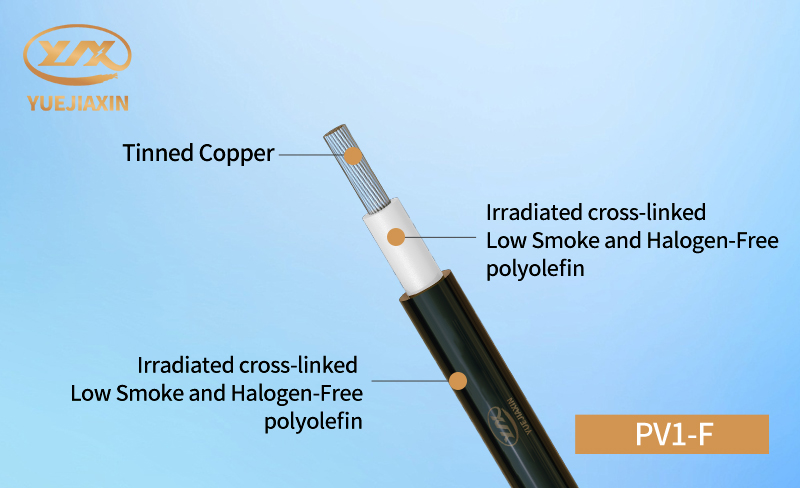
Mainstream photovoltaic (PV) cables (such as PV1-F and H1Z2Z2-K) typically utilize an **electron-beam cross-linked polyolefin (XLPO)** insulation and sheathing system, in compliance with standards including EN 50618, IEC 62930, and TÜV 2 Pf1169/08.2007. Their weather resistance is derived from a three-layered design approach.
The first layer is the material itself: cross-linked polyolefin. Standard polyethylene (PE) is a thermoplastic that softens at high temperatures and degrades under sunlight. Through cross-linking, the molecules form a three-dimensional network, transforming the material into a thermoset. This provides several critical performance characteristics: a long-term operating temperature of 90°C, a short-term overload capacity of up to 120°C, and the ability to withstand 250°C for 5 seconds during a short circuit. It remains functional down to -40°C, making it suitable for extremely cold regions. Furthermore, it is halogen-free and low-smoke, producing minimal smoke and few corrosive gases during combustion—ideal for areas with high human occupancy, such as rooftops or tunnels. It also offers resistance to ozone, acids, alkalis, and oils, allowing for long-term exposure to atmospheric elements and chemical pollutants. The second layer consists of UV-resistant additives, specifically carbon black and light stabilizers. The third layer pertains to structure and manufacturing: a thin-walled, uniform, and tightly integrated design. Most PV cables feature thin-walled insulation and sheathing, which reduces both outer diameter and weight while maintaining the necessary electrical strength. This requires high-precision extrusion; any significant eccentricity or uneven wall thickness can create localized electric field concentrations, which may serve as initiation points for electrical breakdown during long-term operation. Additionally, the sheath and insulation must be tightly bonded to prevent moisture from penetrating longitudinally through any gaps. Before leaving the factory, compliant products must pass a series of type tests—including UV aging (e.g., 720 hours in a xenon-arc or UV chamber), damp-heat aging, ozone resistance testing, salt spray testing, dynamic bending tests, low-temperature impact tests, and insulation resistance testing under water immersion—all of which simulate the rigorous, long-term outdoor conditions the cables are designed to endure.
A photovoltaic (PV) power plant is an asset characterized by a "one-time investment and twenty-year operational lifespan." Within such a system, cables are among the least conspicuous components, yet they are also the most difficult to replace. The term "PV-specific" refers not merely to a product name or model designation, but rather to a design and validation framework—encompassing both materials and structural composition—tailored to the full-lifecycle stress profile of an outdoor environment. For manufacturers, weather resistance and aging durability should not be limited to a single data point in a type-test report; instead, they must be reflected in the stability of material formulations, the precision of the extrusion process, and the consistency across production batches. For those involved in procurement and system design, carefully reviewing standards and verifying voltage ratings and current-carrying capacity adjustments is far more valuable than simply comparing unit prices.